Recognizing the Jumps
When trying to recognize jumps, the following guidelines will help. First, WATCH THE FEET. All jumps are defined by what the feet do — the position of the upper body is essentially irrelevant to the jump (except insofar as it helps the skater to perform it). In fact, since almost all jumps land the same way, it is really the position of the feet on takeoff that makes the difference. So, keep your eyes on those skates just before the skater leaps into the air – in almost all cases this will tell you what jump they are doing.
Directional Preference: Note first that most skaters will jump and spin in a counterclockwise direction (as viewed from above). It is legal to go either way, but for some reason most skaters go counterclockwise — those who don’t are often left-handed. All descriptions below are described for a counterclockwise jumper — if the skater you are watching happens to be a clockwise jumper, just reverse all references to feet. Note second that all major jumps land on a RBO edge — that is to say the skater lands going backwards, on the right foot, skating on an outside edge (a clockwise jumper would land on a LBO edge).
Edge or Toe Jump: Note that some jumps, known as “toe assisted jumps” get a little help in the takeoff by a small push with the toepick on the non-skating foot (or “free foot”). These are generally considered a little easier than those that take off without any assistance — which are called “edge jumps”. Examples of toe-assisted jumps are “toe loops”, “flips”, and “Lutzes”. Examples of edge jumps are “Salchows,” “Axels”, and “Loops”.
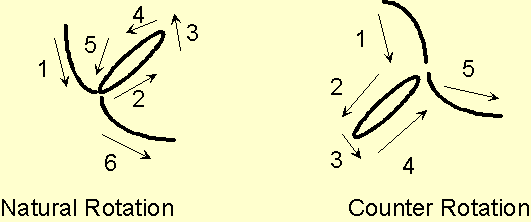
Naturally or Counter Rotated: Note also that most jumps rotate in the “natural” direction. That is to say that the direction of the rotation in the air is the same as the direction of the curve the skater was skating on before he/she leapt into the air. That sounds confusing, but consider that if you are skating on an edge, you will be always describing a curve when you skate. When a skater jumps on a naturally-rotating jump, the rotation is towards the center of the circle described by the skating curve — and the skater’s rotation just naturally continues in the same direction he was skating. Most jumps are “naturally” rotating. A “counter” rotated jump, such as a Lutz is more difficult because the direction of jump rotation is the opposite direction that the skater’s body was moving on the ice.
Direction of Takeoff: Almost all jumps take off while the skater is going backwards. The only common jumps for which this is not true are the "waltz jump" and the "Axel" which both take off from a forward edge (and are thus very easily recognizable). Please be aware though that very often the skater will execute one or more quick turns ON the ice just prior to the takeoff. It is the direction the blade is going at THE MOMENT IT LEAVES THE ICE that is important.
The Approach: There are certain “standard approaches” to most jumps that are very commonly taught. These approaches, or “preparatory moves” usually last a lot longer than the jump itself, and you will probably find that you will do most of your recognitions based on the preps rather than the actual jump (besides it's pretty impressive to outsiders when you can look at some stranger skating and say “she’s getting ready to do a flip...”). Remember though that the preparatory moves are not really a part of the jump, and that skaters may, and occasionally will, use different approaches, so don’t be surprised if someone does something you thought was going to be a flip, and then says, “how’d you like my toe loop?
A Code for Describing the Jumps
Before we talk about the details of the jumps we’re going to digress a second and talk about a shorthand “code” for describing them. Using this code, and a table of jumps (i.e. the Table of Jump Difficulty, found elsewhere on this website) you can figure out jumps that aren’t described in this document. The chart below explains how to read this shorthand code.
| Symbol | Meaning |
|---|---|
| f | forward |
| b | backward |
| o | outside edge |
| i | inside edge |
| ! | toe push |
| ^ | split position |
| X | crossed position |
| T | Natural rotation |
| C | Counter Rotation |
By studying the table you can understand the mechanics of all the jumps. You read each description from left to right — it says what the skater will do, in sequence. When there are numbers, they mean you jump and rotate that many times.
The rest work similarly. The code never indicates which foot you use; so that it may be used equally well for clockwise or counterclockwise jumpers.
Finally, on the the Jumps !
The descriptions on this website are for the most commonly seen jumps. Each description indicates the shorthand code for the jump and describes the most common preparatory positions as well as the takeoff and landing edges. Click the links at the top of this page to view each jump description.Jumps Summary
Thereare other jumps, but these are the ones you will most often see. All of the jumps here have been described as if they were “singles” (one revolution), but all may be performed as doubles or triples as well. Multiple revolution jumps are performed in the same general fashion as their single-revolution counterparts, but the skater pulls in tighter and spins faster (the pro usually says “no problem— just go around one more time...”). Its pretty easy to tell the difference between singles and doubles. The difference between doubles and triples is a little harder to see. and you've got to have a really quick eye to tell the difference between a triple and a quad.
The table below summarizes the most common jumps. It shows the takeoff foot and whether the jump is a toe-assisted jump or an edge jump (remember this is for counter-clockwise rotators; change feet for clockwise rotators).
| Left Foot Takeoff | Right Foot Takeoff | |
|---|---|---|
| Edge Jump | Salchow / Axel (forward takeoff) | Loop / Walley (Counter rotated) |
| Toe-Assisted Jump | Flip / Lutz (Counter rotated) | Toe Loop / Toe Walley (Counter rotated) |